

Forest department busts capiz sea shell company, 20 detained
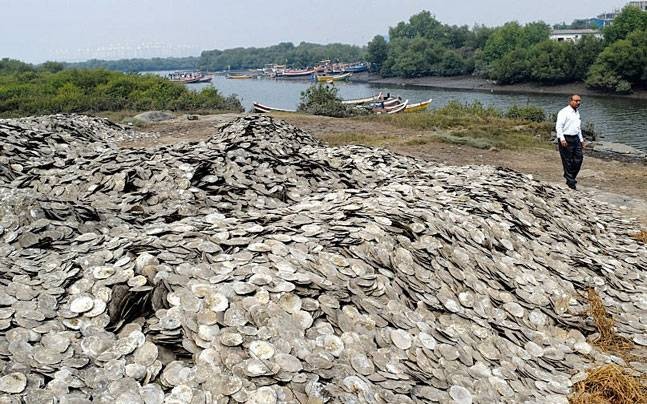
India: The Maharashtra forest department has lately been investigating into a surprise seizure of 80 MT of capiz sea shells from Navi Mumbai's Ulwe area.
The beautiful marine mollusks with a hard, protective outer case are found scattered across sea shores in Gujarat, Maharashtra, Goa and Karnataka. Since ages, they have been harvested and used in furniture, lampshades, cutlery and jewellery pieces.
However, enforcement agencies were surprised to note a new usage - in oil mining rigs in countries of West Asia and Argentina, - for which they were being powdered in a factory in Khopoli and smuggled through the sea route.
At least four lorries were found carrying the contraband material in the backwater mangroves area near Raigad.
FACTORY RAIDED, 20 DETAINED
M Maranko, deputy director of the Wildlife Crime Control Bureau (WCCB), Western Region, said, "We had recently conducted an awareness and training session for the Maharashtra Forest Department, during which we told them about the lesser-known wildlife items trafficked."
"As a result of it, an officer spotted this item in trucks in Ulwe and recognised it as an illegal goods. At least 15-20 labourers were detained and the factory they named was raided. Further questioning is going on," Maranko said.
Though its exact usage in oil rigs is still unclear, the factory owners said the powdered Capiz shell is shoved down big pipes into oil and natural gas beds to condense the natural resource and block it from sinking further into the earth.
As West Asia and Argentina are abundant in oil rigs, it is in high demand there and could have been illegally exported for crores of rupees.
BUSINESS WAS ON SINCE 2015
The shady business was on since 2015, though it came into light only with this catch. Experts said they were hearing of this practice for the first time.
Dr Deepak Apte, director of the Bombay Natural History Society (BNHS), said, "These are live animals (bivalve mollusks), which develop shells from their blood and salt sea water to protect themselves. While the meat is boiled and eaten, the shells and pearls inside are highly-vaued."
"The Wildlife Protection Act, 1972, regulates their trade under Schedule IV. This means that they can be harvested from sea coasts and used in handicrafts etc., but in limited quantities. Sadly, the Schedule IV of WPA is poorly defined and understood. So nobody knows how much can be traded in which State/area and season," he said.
Capiz shells form beautiful rosette-shaped beds in shallow waters and are easily extracted by fishermen. They are much-favoured for usage in windows and jewelry due to their glossy, translucent quality. Till a few years back, they were found in abundance in Gujarat but have vanished due to over-harvesting. "The same thing will happen in Goa and Maharashtra if the laws regarding Capiz shells are not better enforced," Dr Apte added.
(Source: India Today)
